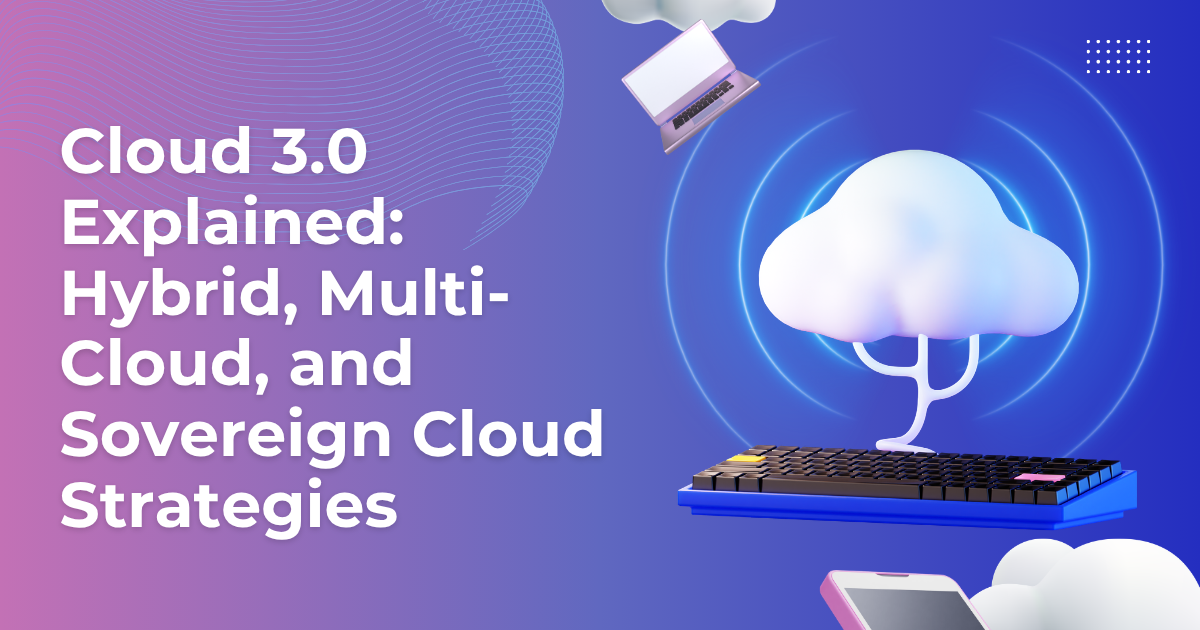
Cloud computing is entering a new stage. The first era focused on moving servers and applications away from physical data centers. The second era emphasized scalability, managed services, and rapid digital transformation. Cloud 3.0 is more strategic. It combines hybrid infrastructure, multi-cloud operations, sovereign data controls, edge computing, and AI-ready architecture.
For businesses, this means the question is no longer simply whether to use the cloud. The important questions are where workloads should run, where data should be stored, who can access it, how applications move between environments, and how the entire system remains cost effective. These questions directly affect Software Development, cybersecurity, compliance, performance, and long-term business resilience.
A modern Software Development Company must understand Cloud 3.0 because applications are increasingly expected to operate across several environments instead of relying on one cloud platform. The goal is not to use more clouds for the sake of complexity. The goal is to place each workload in the environment that best supports its performance, security, regulatory, and commercial requirements.
What Cloud 3.0 means
Cloud 3.0 is not a single product or official technical standard. It is a way to describe the next generation of cloud architecture. It brings together three major strategies:
- Hybrid cloud, which combines private infrastructure with public cloud services.
- Multi-cloud, which uses services from multiple cloud providers.
- Sovereign cloud, which gives organizations stronger control over data location, jurisdiction, and operational authority.
These approaches are increasingly being combined rather than treated as separate choices. A business may keep sensitive customer records in a private or sovereign environment, run analytics through a public cloud, and maintain legacy systems in its own data center. Modern applications must connect these environments securely and consistently.
A sovereign cloud is designed to keep data and related operations under the laws and governance requirements of a specific country or region. That makes sovereignty a core architecture concern rather than a legal issue addressed after development is complete.
Why businesses are moving beyond single cloud
Using one cloud environment can simplify operations, but it can also create dependency. A business may become tied to one provider’s pricing, service design, technical roadmap, and regional availability. If the provider experiences an outage or changes its commercial terms, the customer may have limited alternatives.
A multi-cloud strategy can reduce some of that dependency. It can also allow companies to choose the best environment for each workload. One platform may offer stronger data analytics, another may provide better regional coverage, and another may deliver more suitable infrastructure for a particular application.
However, multi-cloud does not automatically mean resilience. If applications are tightly designed around one provider’s services, moving them elsewhere may be difficult. A real multi-cloud strategy requires portable architecture, compatible interfaces, shared security policies, and strong operational visibility.
For a Software Development Company, this means designing applications with portability in mind from the beginning.
Hybrid cloud provides practical flexibility
Many organizations cannot move everything to a public cloud. They may operate legacy systems, manage sensitive workloads, or face industry requirements that demand private infrastructure. Hybrid cloud offers a middle path by connecting private environments with public services.
A company might keep its core transaction database in a controlled private environment while using public cloud capacity for customer applications, reporting, or development environments. Another business might keep personally identifiable information in a restricted region while processing anonymized data through a larger public platform.
This approach allows businesses to balance control with scalability. It also supports gradual migration, which is often more realistic than replacing every system at once. A hybrid model blends public cloud services with private infrastructure or an internal data center.
For Software Development, hybrid architecture creates both opportunity and responsibility. Developers must understand data movement, network boundaries, identity management, deployment processes, and failure recovery across different environments.
Multi-cloud is more than avoiding vendor lock-in
Vendor lock-in is often presented as the main reason to adopt multi-cloud. While reducing dependency is useful, that is only one part of the strategy. Organizations may also choose multi-cloud to improve availability, meet regional requirements, access specialized services, or optimize costs.
For example, a business could run customer-facing services close to users in multiple regions while placing batch analytics workloads where computing costs are lower. It might use one environment for application hosting and another for disaster recovery. It could also distribute workloads to reduce the effect of a regional outage.
The challenge is that each cloud may use different identity systems, monitoring tools, networking models, and security controls. Without centralized governance, multi-cloud can create operational confusion. A business may end up with several disconnected technology environments rather than one resilient architecture.
A capable Software Development Company should help clients design common standards for logging, identity, deployment, security, and data management across all environments.
Sovereign cloud addresses control and jurisdiction
Data sovereignty has become one of the strongest forces behind Cloud 3.0. Governments and industries increasingly care about where information is stored, where it is processed, which laws apply, and who can access it. These concerns are especially important for public services, financial institutions, healthcare organizations, and companies handling sensitive personal information.
A sovereign cloud strategy can include local data centers, regional operations, locally controlled encryption keys, domestic personnel requirements, or restrictions on cross-border data movement. The exact structure depends on the organization’s legal and operational needs.
This does not mean every workload must stay in one country. It means data should be classified and governed according to its sensitivity. Public or anonymized data may be processed globally, while regulated information remains in an approved jurisdiction.
In Software Development, sovereignty requirements should be translated into technical policies. For example, an application may need rules stating that personal data can only be stored in approved regions, while synthetic data may be used in broader development environments.
AI is accelerating Cloud 3.0
Artificial intelligence is making cloud architecture more complex. AI training and inference require significant computing power, specialized hardware, and access to large datasets. At the same time, AI systems may process sensitive information that cannot move freely across borders.
This creates a need for distributed AI architecture. Training workloads may run in one environment, while inference must happen near the user or inside a sovereign region. Data may need to remain local, even when the AI model is managed through a wider platform.
Cloud 3.0 therefore connects cloud strategy with AI strategy. Businesses must consider where models are trained, where data is processed, how outputs are monitored, and whether external systems can access confidential information.
A Software Development Company working on AI applications needs to design for regional deployment, data classification, model governance, and performance requirements from the earliest planning stage.
Security must work across environments
Cloud 3.0 expands the security perimeter. Instead of protecting one data center or one cloud account, organizations must protect applications, APIs, identities, containers, devices, networks, and data across multiple locations.
A consistent zero trust approach is important. Users and services should be authenticated continuously, and access should be limited according to role and need. Encryption should protect data both in storage and during transfer. Secrets and credentials should be managed centrally rather than embedded in code.
Security policies also need to be automated where possible. Manual configuration is difficult to maintain across several environments. Policy as code can define rules for approved regions, access permissions, encryption settings, and deployment conditions.
For Software Development, this means security can no longer be treated as a final review. It must be integrated into architecture, code repositories, deployment pipelines, and runtime monitoring.
The cost challenge
Cloud flexibility can become expensive if usage is not controlled. Multi-cloud environments make it harder to understand where money is being spent, especially when teams use different billing models and services. Data transfer between clouds can also create unexpected charges.
Businesses need clear cost ownership. Every workload should have an accountable team, budget, usage limits, and performance targets. FinOps practices can help teams connect cloud consumption to business value.
A good Cloud 3.0 strategy does not automatically choose the cheapest environment. It considers the full cost of ownership, including migration, security, operations, support, licensing, data movement, and future flexibility.
How companies should begin
Organizations should not attempt a complete Cloud 3.0 transformation in one step. A practical plan starts with an assessment of the current environment.
First, classify data and workloads according to sensitivity, performance needs, location requirements, and business importance. Next, map how data moves between systems and identify areas where sovereignty or security rules may be violated.
Then, select one workload for a controlled pilot. This could be a development environment, analytics service, or regional application. Use the pilot to test deployment portability, monitoring, access controls, disaster recovery, and cost management.
The business should also define clear policies before choosing tools. For example:
- Which data must remain in a specific region?
- Which workloads require low latency?
- Which systems need multi-region recovery?
- Which services can use public cloud resources?
- Which teams approve cross-border data movement?
A Software Development Company can help translate these business policies into application architecture and deployment controls.
The future of cloud architecture
Cloud 3.0 will not eliminate public cloud, private infrastructure, or data centers. It will connect them through more intelligent and policy-driven systems. Applications will be designed to operate across environments rather than being permanently tied to one location.
The most successful businesses will not necessarily be those using the greatest number of clouds. They will be those that understand their workload requirements and place each system deliberately. They will use automation to enforce governance, observability to understand data movement, and portable architecture to preserve strategic flexibility.
Conclusion
Cloud 3.0 represents a shift from simple cloud adoption to intentional digital infrastructure. Hybrid cloud provides flexibility, multi-cloud supports choice and resilience, and sovereign cloud strengthens control over data and jurisdiction. Together, these strategies help businesses respond to changing regulations, AI demands, security threats, and customer expectations.
For Software Development, the shift means applications must be designed for portability, policy enforcement, distributed data, and consistent security. For every Software Development Company, cloud architecture is becoming a business strategy rather than a deployment detail.
The future will not belong to organizations that simply move everything to the cloud. It will belong to those that understand where each workload belongs, why it belongs there, and how to control it once it arrives.