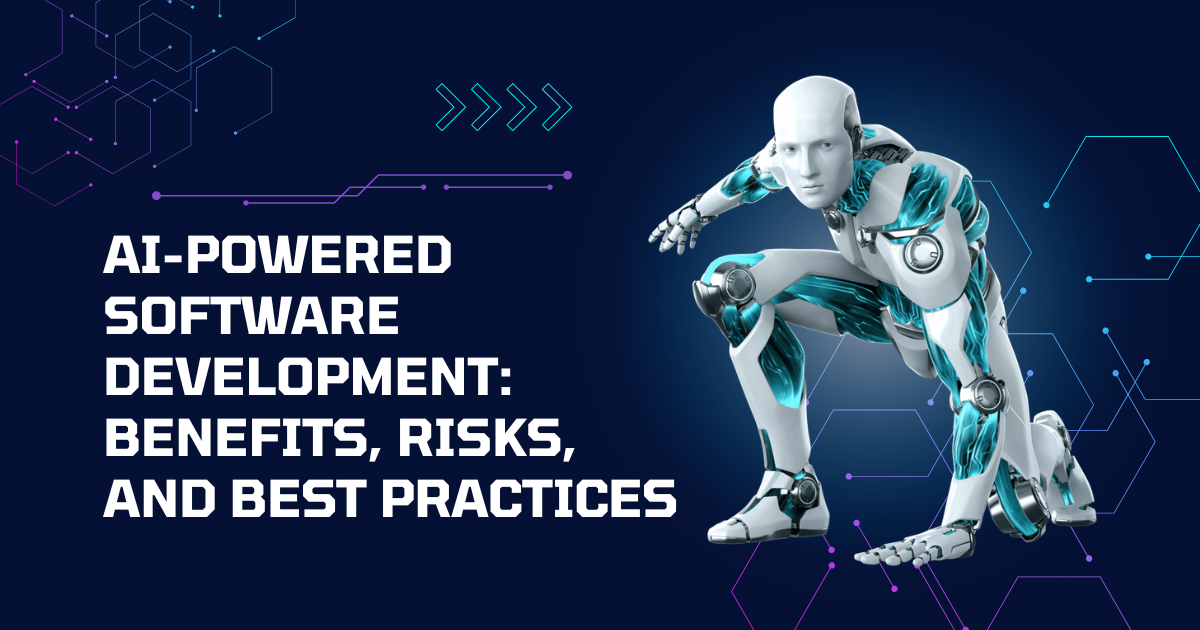
Artificial intelligence is changing how software is planned, built, tested, and maintained. What began as simple code suggestions has developed into a broader AI-powered approach that can support requirements analysis, code generation, testing, debugging, documentation, and deployment. For every Software Development Company, this shift creates new opportunities to deliver products faster and improve engineering productivity. It also introduces risks that cannot be ignored.
AI can automate repetitive tasks, help developers understand unfamiliar code, and identify possible defects earlier in the development lifecycle. Research on AI in software development highlights productivity, improved quality, faster planning, and automation as major advantages. However, AI-generated code can still contain security flaws, logical errors, outdated assumptions, or unnecessary complexity. The best results come from treating AI as a capable engineering partner rather than an unchecked replacement for human expertise.
What AI-powered development means
AI-powered Software Development refers to the use of artificial intelligence across the software lifecycle. It includes tools that generate code, explain functions, create test cases, review pull requests, identify bugs, summarize documentation, and assist with system design.
The newer generation of tools goes beyond responding to individual prompts. AI agents can plan multi-step tasks, use development environments, inspect repositories, run tests, and suggest changes based on the results. Current analysis suggests that autonomous systems are beginning to compress development tasks that once took weeks into days or even hours, although the amount of human review required depends on the project’s risk and complexity.
This does not mean every project should become fully autonomous. It means development teams now have more ways to automate work while keeping humans responsible for architecture, quality, security, and business decisions.
The main benefits
Faster development cycles
The most visible benefit of AI-powered development is speed. AI tools can create boilerplate code, generate common functions, write documentation, and produce initial test cases in a short time. This allows developers to spend less time on repetitive work and more time solving difficult problems.
A Software Development Company can use this advantage to shorten the time between a client’s idea and the first working prototype. Faster prototyping also makes it easier to test different approaches before committing to a large investment.
However, speed should not be confused with immediate production readiness. AI can accelerate the first draft, but experienced developers still need to validate the result.
Improved testing and quality checks
AI can support testing by generating unit tests, identifying edge cases, and analyzing code for potential errors. It can also examine patterns across a codebase and highlight areas that may need refactoring or additional coverage.
Automated static analysis and security scanning are especially useful when applied to AI-generated code. These tools can check for issues such as excessive complexity, unused variables, weak error handling, and known security weaknesses.
The result can be a more consistent review process, especially for teams managing large applications. AI can act as an additional layer of examination, but it should not be the only layer.
Better developer productivity
Developers often lose time searching through documentation, understanding old code, or trying to reproduce difficult errors. AI assistants can summarize unfamiliar modules, explain dependencies, suggest debugging steps, and convert technical information into plain language.
This can make onboarding easier for new team members. It can also reduce frustration among experienced developers who spend too much time handling maintenance tasks. When used carefully, AI allows engineers to focus more on architecture, performance, user experience, and problem-solving.
More accessible software creation
AI-powered tools are lowering some barriers to software creation. Product managers, analysts, designers, and business users can describe ideas in natural language and receive prototypes or workflow drafts. This does not eliminate the need for professional developers, but it can improve communication between technical and nontechnical teams.
For a Software Development Company, this can lead to better collaboration during discovery and planning. Stakeholders can test ideas earlier and give feedback before a full development cycle begins.
The risks of AI-powered development
Incorrect or insecure code
AI tools generate likely answers, not guaranteed answers. They can produce code that looks convincing while containing subtle defects. A function may work in a simple test but fail with unusual inputs. A database query may expose sensitive records. An authentication flow may appear complete while missing an important security control.
This risk becomes more serious when developers accept suggestions without understanding them. AI-generated code should be reviewed with the same care as code written by a person. In fact, it may require additional attention because its origin can make mistakes harder to detect.
Intellectual property concerns
AI-generated code can raise questions about ownership, licensing, and intellectual property. Teams may not always know what sources influenced a suggestion or whether a generated component resembles code governed by restrictive licensing terms. Publicly available models and tools can also create concerns about confidential code being exposed during processing.
Every Software Development Company should establish clear rules about which repositories, credentials, customer data, and proprietary materials may be used with AI tools. Technical convenience should never override contractual or legal obligations.
Overreliance on automation
A team that depends too heavily on AI may gradually lose important engineering knowledge. Developers might accept generated architecture without questioning its tradeoffs. Junior professionals may produce code without learning why certain design patterns exist. Over time, this can weaken the team’s ability to investigate failures independently.
AI should increase engineering capability, not replace understanding. Teams need people who can review generated output, challenge assumptions, and take responsibility when systems behave unexpectedly.
Code bloat and maintenance problems
AI makes it easy to generate more code, but more code is not always better. Developers may accept unnecessary abstractions, duplicate logic, or overly complex solutions because the tool can produce them quickly. This creates maintenance debt and makes future changes harder.
AI-generated code can also appear consistent while hiding inconsistent design decisions across different parts of an application. Regular refactoring and architecture reviews remain necessary. A fast first release can become expensive if the underlying codebase is difficult to maintain.
Data privacy and security
AI development tools may process source code, logs, tickets, and documentation. If sensitive information is sent to an external system without proper controls, the organization may create a privacy or security risk.
Companies need to understand how each tool handles data, whether information is retained, where it is processed, and who can access it. They should also prevent credentials, customer information, and confidential business logic from entering prompts or training workflows without authorization.
Best practices for responsible adoption
Begin with a clear use case
Do not introduce AI simply because it is popular. Start with a specific problem, such as test generation, documentation, code explanation, or repetitive refactoring. Define what success means before choosing a tool.
A focused pilot makes it easier to measure productivity, quality, error rates, and developer satisfaction. It also reduces the risk of introducing AI into high-impact systems before the team understands its limitations.
Write a specification first
AI performs better when the problem is clearly defined. Before asking a tool to generate production code, create a written specification that describes inputs, outputs, constraints, security requirements, edge cases, and expected behavior.
A clear specification gives the developer something to evaluate against. Without one, the team may judge the output only by whether it looks reasonable. Production Software Development requires more than appearance. It requires verifiable behavior.
Keep humans in the review loop
Every important AI-generated change should pass through human review. The reviewer should understand the relevant programming language, architecture, data model, and security requirements. Automated checks are useful, but they cannot replace accountability.
A strong review process may include static analysis, automated tests, security scanning, an AI-assisted review, and a senior engineer’s final assessment. Human oversight is widely recommended because automated systems may overlook errors or security issues.
Use layered testing
AI-generated code should be tested at multiple levels. Unit tests can confirm individual functions. Integration tests can verify interactions between services. Security tests can identify vulnerabilities. Performance tests can reveal problems that are invisible during normal development.
Teams should also test unusual inputs, permission boundaries, failure conditions, and rollback behavior. In Software Development**, the most damaging defects often appear outside the happy path.
Track AI-generated contributions
Organizations should keep records of how AI tools are used. This does not require documenting every suggestion, but teams should know which parts of a system were generated or substantially modified with AI assistance.
This helps with future maintenance, security reviews, compliance questions, and incident investigation. It also encourages developers to take ownership of the final code rather than treating AI output as untraceable material.
Train people before scaling tools
Tools alone do not create responsible AI adoption. Developers need training in prompt design, output evaluation, secure coding, intellectual property, data privacy, and model limitations. Business teams also need to understand where AI is useful and where expert review is mandatory.
For a Software Development Company, training should be continuous because AI capabilities and risks are changing quickly. A short workshop can be valuable, but teams also need standards, examples, review checklists, and leadership support.
Protect critical systems
Not every part of an application should receive the same level of automation. Companies should identify critical capabilities that require strict human control, such as payment processing, authentication, medical logic, safety systems, and sensitive data access.
A practical approach is to experiment first with low-risk workflows while ring-fencing systems that cannot tolerate unreviewed changes. This risk-based adoption model is recommended in current guidance on capturing value from AI-powered development.o
The future of AI-powered development
AI will continue to change the roles of developers, managers, testers, and product teams. Developers will spend more time reviewing systems, guiding agents, designing architecture, and handling complex technical decisions. Product professionals will need to describe requirements more precisely. Security specialists will need to assess both traditional vulnerabilities and AI-specific risks.
The strongest organizations will not measure success only by how much code AI generates. They will measure whether the software is more reliable, secure, maintainable, and valuable to users. That is the standard that separates meaningful transformation from superficial automation.
Conclusion
AI-powered Software Development offers major benefits, including faster delivery, better testing support, improved productivity, and wider participation in software creation. It also introduces real risks involving security, privacy, intellectual property, code quality, and overreliance on automation.
For every Software Development Company, the right approach is balanced adoption. Start with practical use cases, define requirements clearly, test AI-generated output thoroughly, protect sensitive information, and maintain human accountability for important decisions. AI can help teams build faster, but responsible engineering is still what makes software trustworthy.